Agentic Context Management
Your AI Agents Forget.Synap Makes Them Remember.
Persistent memory and context for AI agents, across all popular agent frameworks.
No credit card required. Google or GitHub sign-in.











Memory is not a storage problem alone.It is an active context-management problem.
Every other tool stores and retrieves. Synap actively manages context for your agent, per agent, per domain, per customer.
01What you get
What changes when your agent can actually remember
Remembers every user
- Recall across sessions, channels, and months, not just the last twenty turns
- "Sarah," "Sarah Chen," and "SC" resolve to one person automatically
Under the hood: structured capture and entity resolution.
Remembers your organization
- Shared policies, product knowledge, and team context for every agent that should see them
- Isolated from the users and tenants that should not
Under the hood: customer and client scopes.
Without the token bill
- Context stays lean as conversations grow, so cost does not balloon and quality does not rot
- Compaction keeps the signal, drops the noise, and tells you when it worked
Under the hood: validated compaction.
Fast enough for voice
- Context is pre-fetched before your agent asks, returning in 15ms at P50
- A voice agent stays conversational instead of pausing
Under the hood: anticipatory retrieval.
02Not a vector database
A vector database is not memory.
Retrieval finds text that looks similar. Memory maintains what is true, current, and yours. You can bolt the missing pieces on one at a time, or you can use a system that was built to manage them together.
03How it works
How Synap works
A conversation turn does not land in a database. It runs through a pipeline that turns raw dialogue into structured, scoped memory, governed by an architecture generated for your specific agent.
Scroll the diagram sideways to follow the full path →
04Inside Synap
What makes it managed, not just stored
Custom architecture per agent
- Generates a memory architecture for each agent from a use-case description
- Manages and adapts it as the session grows, with no schema to hand-author
Structured extraction and entity resolution
- Raw text becomes facts, preferences, episodes, emotions, and temporal events
- Mentions of one person or company collapse to a single entity; ambiguous matches go to a review queue, not a guess
Validated compaction
- Compaction is not summarization
- Every pass returns a validation score and a preserved-facts count, so you know when compression kept the signal
Automated scoping
- Memory is isolated across User, Customer, and Client, applied automatically
- One user's memory never leaks into another's session, and shared knowledge stays shared
Also built in
05Scopes
The right memory reaches the right tenant, and never leaks
User to Customer to Client. When your agent handles a ticket from someone at Acme, it sees what you know about that user, about Acme, and about your product globally, ranked so the most specific answer wins.
Shared product knowledge, visible to everyone
Policies, team, and shared projects for this tenant
Facts, preferences, and episodes about this person
private to Alice
Policies, team, and shared projects for this tenant
Facts, preferences, and episodes about this person
private to Bob
06Proof
Highest accuracy, lowest latency, and you can check it yourself
Synap scores 92% on LongMemEval, the benchmark that tests whether a memory system retrieves the right fact from a long conversation and holds that accuracy as the conversation grows. Retrieval is 15ms at P50. These numbers are a consequence of the architecture, not prompt tricks. The methodology is published and the eval harness is open source, so you can run it against any system you are evaluating.
| Synap | Mem0 | Zep | Supermemory | |
|---|---|---|---|---|
| LongMemEval | 92% | 57.5% | 63.8% | 71.3% |
| P50 retrieval latency | 15ms | 180ms | Not published | 220ms |
| Entity resolution | Automatic, every tier | Pro tier only | Automatic | Fact extraction |
| Open-source eval harness | Full config published | No | No | No |
07Where it runs
Works across conversational, voice, and workflow agents
Synap is not limited to a fixed list. It manages memory for customer support and sales agents, voice concierges, healthcare assistants, and multi-agent workflows alike. These are a few of the places teams run it today.
See all Synap use cases →08Security and trust
Built for production and for enterprise
Our full security posture is published in one place: data flow, hosting, encryption, retention, deletion, subprocessors, tenant isolation, and DPA availability. Read the security and privacy page →
Enterprise plans add VPC and private deployment, SSO and SAML, configurable RBAC, and custom SLAs. See plans and enterprise options →
Get started
Start building with Maximem Synap
No credit card required. Google or GitHub sign-in.
Frequently Asked Questions
Synap is Maximem's agentic context management layer for AI agents. It gives your agents persistent, cross-session memory with automatic entity resolution, temporal awareness, and anticipatory retrieval. Synap integrates natively with 22 frameworks (LangChain, LangGraph, LlamaIndex, OpenAI Agents, Pydantic AI, CrewAI, AutoGen, Google ADK, Haystack, Agno, Semantic Kernel, Microsoft Agent Framework, NeMo Agent Toolkit, LiveKit Agents, Pipecat, Claude Agent SDK, Mastra, Vercel AI SDK, Vercel eve, Strands Agents, CAMEL-AI, and Smolagents) and scores 92% on the LongMemEval benchmark and 93.2% on LoCoMo. Free tier available with no credit card required.
Synap offers native SDK integrations for 22 agentic frameworks: LangChain, LangGraph, LlamaIndex, OpenAI Agents, Pydantic AI, CrewAI, AutoGen, Google ADK, Haystack, Agno, Semantic Kernel, Microsoft Agent Framework, NeMo Agent Toolkit, LiveKit Agents, Pipecat, Claude Agent SDK, Mastra, Vercel AI SDK, Vercel eve, Strands Agents, CAMEL-AI, and Smolagents. Install the SDK, configure your API key, and start managing context with a few lines of code. Most developers are up and running in under 5 minutes. Visit docs.maximem.ai for the Quickstart guide, SDK reference, and framework-specific integration examples.
Synap provides Python and TypeScript/JavaScript SDKs, plus a REST API that works with any language. The SDK includes native wrappers for 22 agentic frameworks. Visit docs.maximem.ai for the latest SDK availability, language-specific guides, and API reference.
Synap manages memory through customized memory architectures built for each use case. It handles ingestion (deciding what to store), retrieval (surfacing the right context at the right time, including anticipatory pre-fetching at 15ms P50 latency), entity resolution (linking references like "my manager" and "Sarah" across sessions), temporal awareness (weighting recent context higher than stale context), and conscious forgetting (processing retractions and contradictions). All of this happens automatically without the agent needing to manage its own memory.
Yes. Synap is built with enterprise-grade security including encryption at rest, strict data isolation, and compliance-ready architecture. Enterprise plans include VPC/private deployment options, SSO/SAML, configurable RBAC, custom SLAs, and dedicated customer success management. Synap also supports BYOK (Bring Your Own Key) so you can use your own AI model provider credentials. Contact [email protected] for enterprise pricing and security documentation.
Synap takes a fundamentally different architectural approach. Where Mem0 applies a universal memory model (extracted facts plus embeddings), Synap builds customized memory architectures per use case. Where Zep is built around a temporal knowledge graph (Graphiti), Synap focuses on anticipatory retrieval and latency optimization. On the LongMemEval benchmark, Synap scores 92% accuracy and 93.2% on LoCoMo, measured on an open-source harness anyone can reproduce. Synap also supports 22 agentic frameworks natively (LangChain, LangGraph, LlamaIndex, OpenAI Agents, Pydantic AI, CrewAI, AutoGen, Google ADK, Haystack, Agno, Semantic Kernel, Microsoft Agent Framework, NeMo Agent Toolkit, LiveKit Agents, Pipecat, Claude Agent SDK, Mastra, Vercel AI SDK, Vercel eve, Strands Agents, CAMEL-AI, and Smolagents) and delivers P50 retrieval latency of 15ms. Both Mem0 and Zep are solid tools. We encourage developers to evaluate all three against their specific use case. Read the full Synap vs Mem0 comparison at maximem.ai/compare/maximem-synap-vs-mem0 and Synap vs Zep at maximem.ai/compare/maximem-synap-vs-zep.
Supermemory is multimodal-first with connectors for documents, images, videos, and URLs. Synap is conversation-and-agent-first. If you need to process diverse content types into a searchable memory layer, Supermemory covers that well. If you need the highest verified accuracy (92% on LongMemEval, 93.2% on LoCoMo) at low latency for multi-turn AI agents (customer support, voice AI, workflow agents), that is Synap's focus. Synap's architecture is built around anticipatory retrieval (15ms P50), automatic entity resolution, temporal awareness, and conscious forgetting, which are capabilities specifically designed for agentic workloads rather than general-purpose document memory. Read the full Synap vs Supermemory comparison at maximem.ai/compare/maximem-synap-vs-supermemory.
The SDK and the benchmark eval harnesses are open source, available on GitHub at https://github.com/maximem-ai/maximem_synap_sdk. You can self-host the full stack; we support it, it is just not out of the box. The managed cloud runs the engine, and adds the dashboard, analytics, and a free tier with no credit card required.
From the blog
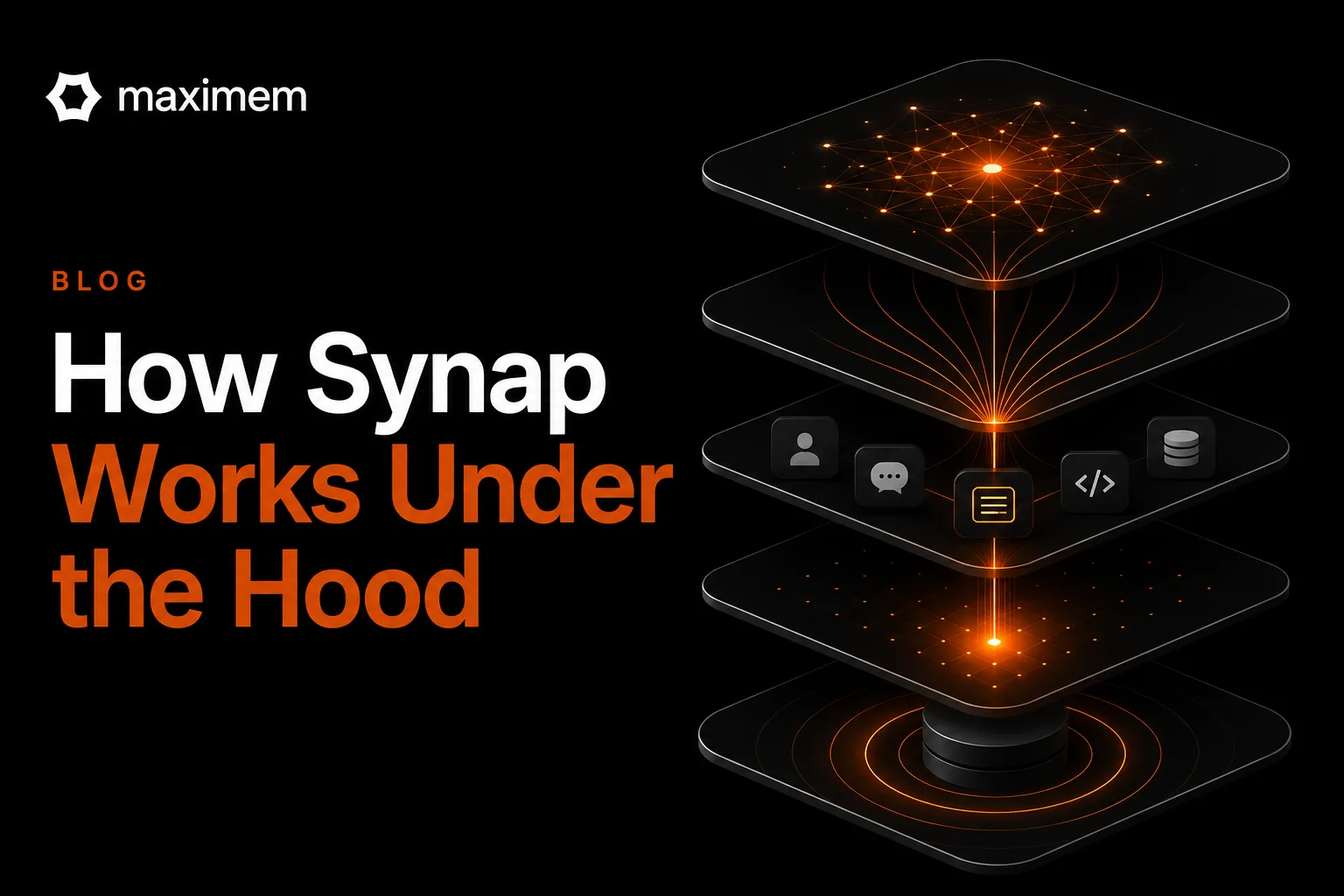
How Synap Works Under the Hood
We launched Maximem Synap today. Here's a peek into how it is built.
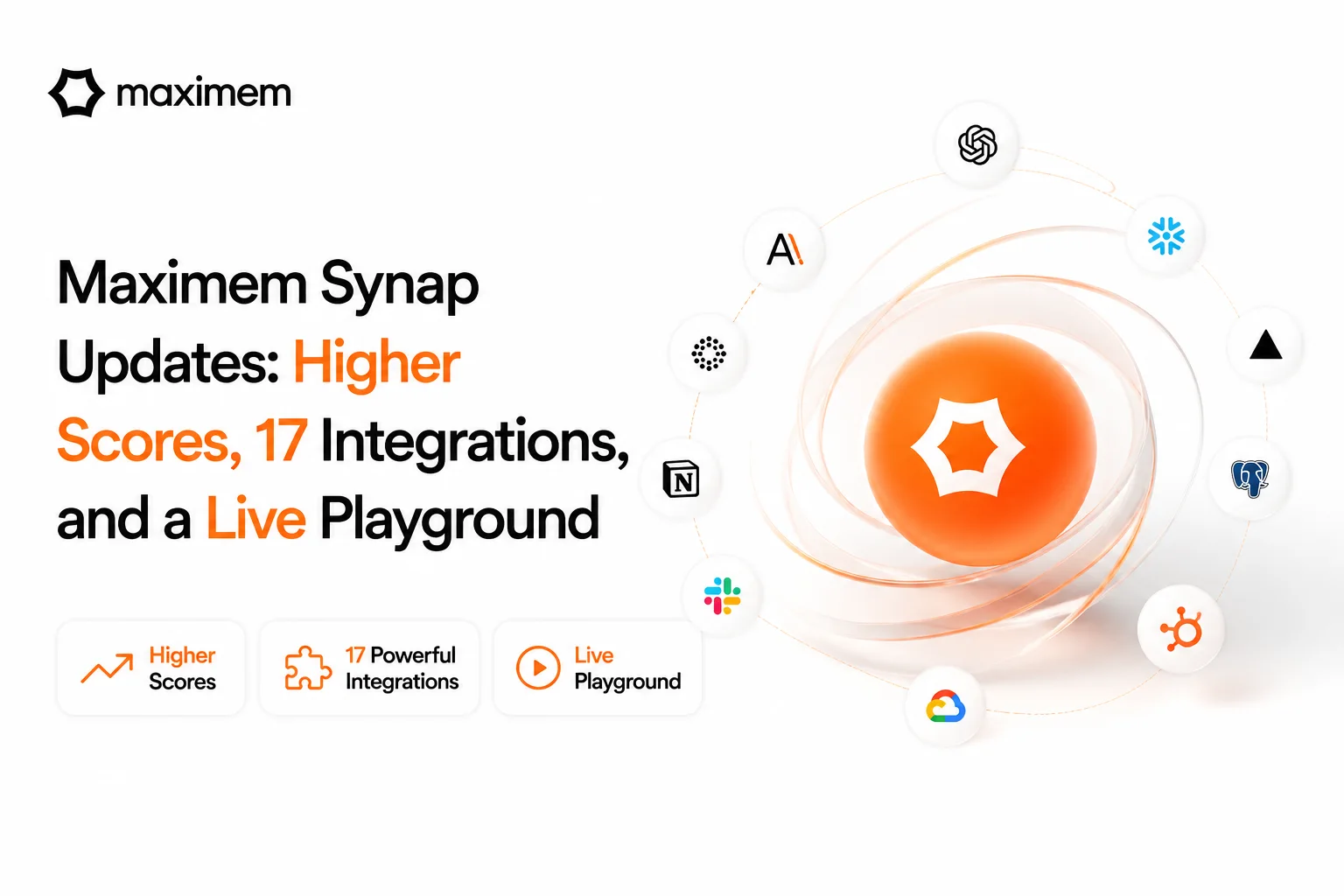
Maximem Synap Updates: Higher Scores, 17 Integrations, and a Live Playground
Synap updates: 92% LongMemEval (up from 90.2%), 93.2% LOCOMO, 17 framework integrations, a browser playground, public pricing, and a free accuracy eval on your own agent.
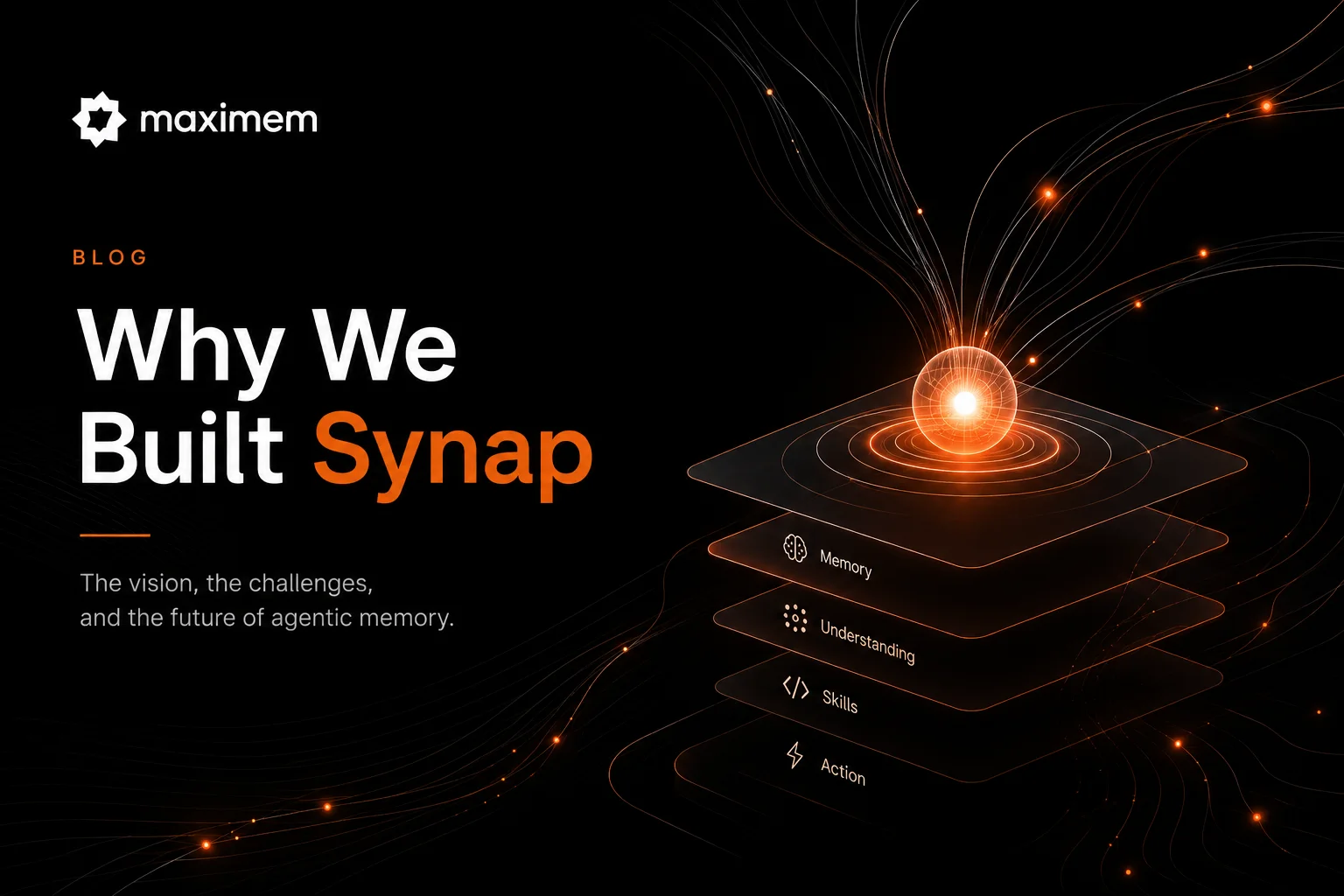
Why We Built Synap
AI agents don’t fail from lack of memory, they fail because context doesn’t evolve. This article shows why current approaches break, introduces the Context Management Trilemma, and how Synap enables agents to learn, adapt, and stop forgetting over time.